Just The Convex Hull
Abstract
I sometimes hear that current AI systems merely allow filling in the convex hull of existing knowledge11 1 I tried looking for the origin of this expression. It’s old: Ola Olsson (2000): Knowledge as a Set in Idea Space, or Hod Lipson (2006) in Curious and Creative Machines. Sometimes this seems to be a claim that AI isn’t such a big deal after all. As far as I can tell, the merely-convex-hull viewpoint is still a pretty radical outcome for the world.
1 It’s Just Convex Hulling
As we all know, in October 2026, LLMs have full competence within the convex hull of expressed human thought, zero reach outside it, and will always result in mediocrity.
And, of course, being within what mathematicians call the ‘convex hull’ of that data means that, for LLMs, AGI remains forever out of reach.
Despite my sarcasm, I do have some sympathy for these opinions. There are also more reasonable convex-hull-pilled takes too.
I think the reason “just fill in the convex hull” can sound like an AI-diss is that it gives you a fixed point: taking a convex hull twice is the same as taking it once. So it evokes an image of progress grinding to a standstill.
There are ways this could be true, I guess: if the AI makes discoveries and then those discoveries don’t help humans much in coming up with new discoveries.
There is an even stronger version of this way of thinking. Namely, that the AI will actually slow down the generation of new knowledge: If you bulldoze through the important open questions in a field, you might paradoxically slow it down by removing lots of serendipitous effects that arise during the attempt to answer those questions.
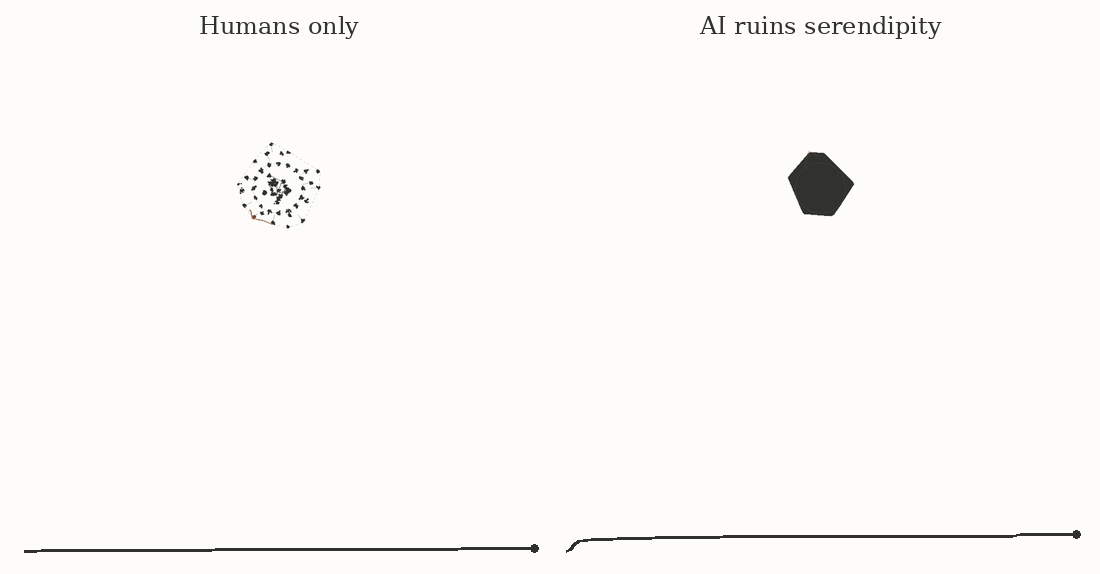
2 Repeated Convex Hulls Might Be Crazy
Of course, taking a convex hull doesn’t mean we’re stuck at a fixed point, though. Humans can expand the boundary of our knowledge, and AI can take the convex hull again!
Even “filling in the convex hull” once, taken literally, could give us an incredible amount of new knowledge. There could also be a compounding effect in knowledge acquisition, i.e., knowing more makes it easier to get to know more.
This also seems… pretty likely? Imagine AI discovering a more efficient algorithm that lets you do larger experiments than before, and then there’s a bigger “hull” to fill in again. Repeated “convex hulls” of all knowledge could then be varying degrees of crazy.
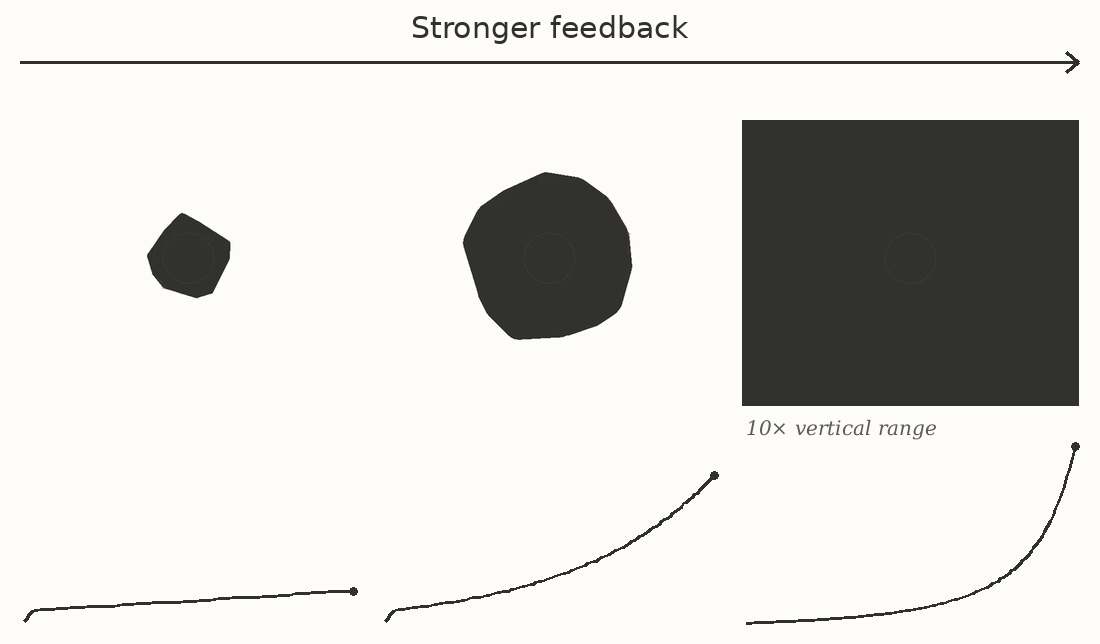
Even the weak-feedback version fills in a dramatically different amount of discovery-space. I’m less keen on meditating on the RSI-like enveloped-by-black panel :)